Rover: MOT pass rate and reliability
Rover vehicles pass the MOT first time 70.2% of the time, measured across 30,801 DVSA tests. That is 6.8 points worse than the 77% national average, ranking Rover 44 of 50 major brands sold in the UK.
Bidding on a damaged Rover at Copart? Run the lot through the salvage profit analyzer for the repair cost, fees, VAT and your maximum bid. Buying a used Rover, damaged or not? Run its registration through the free vehicle history check first: these are brand averages, that page checks the exact car.
Every brand ranked
- Ferrari - 95.9%
- LEVC - 95.4%
- Aston Martin - 93.2%
- Bentley - 92.5%
- Porsche - 88.7%
- Lexus - 87.7%
- Tesla - 84.8%
- Maserati - 84.3%
- MG - 83.9%
- BMW - 82.5%
- Jaguar - 81.9%
- Abarth - 81.8%
- Audi - 81.6%
- MINI - 81.6%
- Toyota - 81.3%
- Land Rover - 80.6%
- Skoda - 80.6%
- Mercedes-Benz - 79.9%
- Suzuki - 79.5%
- Kia - 78.9%
- Hyundai - 78.8%
- SEAT - 78.7%
- Subaru - 78.6%
- Honda - 78.3%
- Dacia - 78.3%
- Volvo - 78.2%
- Jeep - 78%
- Smart - 77.6%
- Volkswagen - 77.1%
- Mazda - 77%
- Mitsubishi - 76.9%
- DS - 76.2%
- London Taxis International - 75.5%
- Ford - 74.8%
- Isuzu - 73.7%
- Nissan - 73.4%
- Peugeot - 73.2%
- Fiat - 73%
- Ssangyong - 73%
- Vauxhall - 72.4%
- Alfa Romeo - 72.4%
- Citroen - 70.8%
- Iveco - 70.2%
- Rover - 70.2%
- Saab - 69.1%
- Renault - 68.1%
- Chrysler - 67.2%
- Daihatsu - 67.1%
- Chrysler-Jeep - 67%
- Chevrolet - 62.8%
Rover models
- Rover MINI - 73.7%, 11,138 tests
- Rover 75 - 62.6%, 7,626 tests
- Rover 25 - 69.2%, 3,244 tests
- Rover 45 - 62.1%, 2,021 tests
- Rover 216 - 70.7%, 728 tests
- Rover Metro - 70.4%, 668 tests
- Rover 214 - 67.9%, 626 tests
Most common MOT failures across every Rover
Pooled across all Rover models, not just one: what actually fails on a Rover more than the UK average.
- Emissions levels exceed default limits, 4.1% of tests (11.51x the national rate for this defect)
- The strength or continuity of the load bearing structure within 30cm of any sub-frame, spring or suspension component mounting (a 'prescribed area') is significantly reduced or inadequately repaired, 7.9% of tests (8.32x the national rate for this defect)
- Vehicle structure corroded to the extent that the rigidity of the assembly is seriously reduced, 2.4% of tests (5.77x the national rate for this defect)
- Brakes imbalance across an axle such that the braking effort from any wheel is less than 70% of the maximum effort recorded from the other wheel on the same axle., 2.6% of tests (4.91x the national rate for this defect)
- Steering rack gaiter or ball joint dust cover missing or no longer prevents the ingress of dirt etc, 2.4% of tests (3.28x the national rate for this defect)
- Exhaust system leaking or insecure, 2.2% of tests (2.2x the national rate for this defect)
- A transmission shaft constant velocity joint boot missing or no longer prevents the ingress of dirt etc, 3.3% of tests (2.18x the national rate for this defect)
- The aim of a headlamp is not within limits laid down in the requirements, 5.1% of tests (2.17x the national rate for this defect)
- Parking brake efficiency below minimum requirement, 2.8% of tests (2.11x the national rate for this defect)
- Significant brake effort recorded with no brake applied indicating a binding brake, 1.9% of tests (1.88x the national rate for this defect)
From 31,173 DVSA-tracked Rover tests, 2024. DVSA testers marked 3.37% of these flagged defects as "dangerous", against 5.11% nationally.
Most common MOT advisories across every Rover
An advisory doesn't fail the car - the tester flags it as worth watching, but it still passes. Pooled across all Rover models, this is a different list from the failures above.
- The strength or continuity of the load bearing structure within 30cm of any sub-frame, spring or suspension component mounting (a 'prescribed area') is significantly reduced or inadequately repaired, 8.5% of tests (5.6x the national rate for this advisory), also fails
- A wheel bearing with excessive play, 3.2% of tests (4.97x the national rate for this advisory)
- Vehicle structure corroded to the extent that the rigidity of the assembly is seriously reduced, 5.5% of tests (4.44x the national rate for this advisory), also fails
- Brake pipe damaged or excessively corroded, 16% of tests (2.58x the national rate for this advisory)
- A suspension component excessively damaged or corroded, 11.1% of tests (2.15x the national rate for this advisory)
- Fluid leaking excessively and likely to harm the environment or to pose a safety risk to other road users, 11.8% of tests (2.12x the national rate for this advisory)
- Exhaust system leaking or insecure, 6% of tests (2.12x the national rate for this advisory), also fails
- Lamp emitted colour, position or intensity not in accordance with the requirements, 2.8% of tests (2.06x the national rate for this advisory)
- Significant brake effort recorded with no brake applied indicating a binding brake, 3.6% of tests (1.8x the national rate for this advisory), also fails
- Number plate inscription missing or illegible, 4.2% of tests (1.57x the national rate for this advisory)
From 31,173 DVSA-tracked Rover tests, 2024.
More on brand reliability
- Britain's most and least reliable car brands: MOT pass rate by manufacturer
- Which car brands beat their age on the MOT test? 33 million tests, ranked
- The cheapest, most reliable makes to buy at salvage auction
Embed this data
Run a site about Rover? Embed the real DVSA pass-rate badge free, linked back to this page.
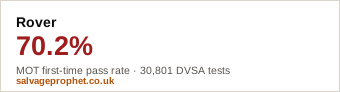
<a href="https://www.salvageprophet.co.uk/mot/make/rover"><img src="https://www.salvageprophet.co.uk/badge/make/rover.svg" width="340" height="92" alt="Rover MOT Pass Rate: 70.2% - Salvage Prophet"></a>Run a garage or parts site? Embed Rover's top real failure reason instead, linked back here.
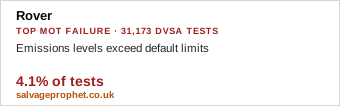
<a href="https://www.salvageprophet.co.uk/mot/make/rover"><img src="https://www.salvageprophet.co.uk/badge/make/failure/rover.svg" width="340" height="106" alt="Rover most common MOT failure: Emissions levels exceed default limits (4.1% of tests) - Salvage Prophet"></a>