Rover 45: MOT pass rate and reliability data
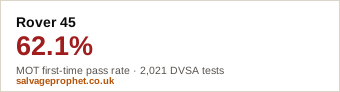
The Rover 45 fails its first MOT more often than the average UK car, by 14.6 percentage points. These figures come from the DVSA's full year of anonymised MOT results, covering 2,021 individual Rover 45 tests. Nothing here is an estimate or a survey.
The numbers
| First-time pass rate | 62.1% |
| UK national average | 76.7% |
| Difference | -14.6 points |
| Tests analysed | 2,021 |
| Average mileage at test | 78,561 miles |
| Average year of manufacture | 2003 |
| Reliability rank | 1,913 of 2,005 models |
What this means if you are buying one
A 62.1% first-time pass rate means roughly 38 in every 100 Rover 45s presented for MOT fail on the first attempt. That is worse than average, so budget for remedial work and treat a fresh 12-month MOT as a genuine selling point rather than a given. The average Rover 45 tested had covered 78,561 miles and was built around 2003.
What this means at salvage auction
Pass rate is a proxy for what a car costs to keep on the road. The Rover 45 sits 14.6 points below the national average, ranked 1,913 of 2,005 models. On one bought as repairable salvage, assume the mechanical side needs more than the visible accident damage, and pad your repair estimate accordingly.
Before you bid: run the lot through the analyzer, check the car's own record, check the mileage, decode the VIN, and if it carries a marker use the write-off value calculator. Or compare it against another model.
Looking at a specific Rover 45 rather than the model in general? The free check covers its MOT and mileage history, and the full HPI report confirms the insurance write-off category, outstanding finance and whether it is recorded stolen, from licensed data for 5 credits. Already own one that has been damaged? Work out whether fixing it beats selling it with the repair or scrap calculator, and see recorded closing bids for damaged Rover 45s at UK salvage auction.
Most common MOT failures on a Rover 45
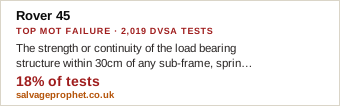
- The strength or continuity of the load bearing structure within 30cm of any sub-frame, spring or suspension component mounting (a 'prescribed area') is significantly reduced or inadequately repaired, 18% of tests (19.04x the national rate for this defect)
- Vehicle structure corroded to the extent that the rigidity of the assembly is seriously reduced, 4% of tests (9.71x the national rate for this defect)
- An SRS malfunction indicator lamp (MIL) indicates a system malfunction, 2.8% of tests (6.8x the national rate for this defect)
- A transmission shaft constant velocity joint boot missing or no longer prevents the ingress of dirt etc, 8.5% of tests (5.53x the national rate for this defect)
- Significant brake effort recorded with no brake applied indicating a binding brake, 4.5% of tests (4.3x the national rate for this defect)
- Exhaust system leaking or insecure, 4.3% of tests (4.26x the national rate for this defect)
- Brake pipe damaged or excessively corroded, 3.2% of tests (3.01x the national rate for this defect)
- Stop lamp missing, inoperative or in the case of a multiple light source more than 1/2 not functioning, 3.2% of tests (2.33x the national rate for this defect)
- Parking brake efficiency below minimum requirement, 2.9% of tests (2.24x the national rate for this defect)
- The aim of a headlamp is not within limits laid down in the requirements, 5.1% of tests (2.15x the national rate for this defect)
From 2,019 DVSA-tracked Rover 45 tests, 2024. DVSA testers marked 3.19% of these flagged Rover 45 defects as "dangerous", meaning the tester judged the car unsafe to drive away, against 5.11% nationally.
Most common MOT advisories on a Rover 45
An advisory doesn't fail the car - the tester flags it as worth watching, but it still passes. A different list from the failures above: what testers are noting on a Rover 45 before it actually fails on it.
- The strength or continuity of the load bearing structure within 30cm of any sub-frame, spring or suspension component mounting (a 'prescribed area') is significantly reduced or inadequately repaired, 21% of tests (13.8x the national rate for this advisory), also fails
- Vehicle structure corroded to the extent that the rigidity of the assembly is seriously reduced, 10.4% of tests (8.36x the national rate for this advisory), also fails
- Significant brake effort recorded with no brake applied indicating a binding brake, 8.8% of tests (4.39x the national rate for this advisory), also fails
- Exhaust system leaking or insecure, 9.1% of tests (3.19x the national rate for this advisory), also fails
- Brake pipe damaged or excessively corroded, 19.5% of tests (3.15x the national rate for this advisory), also fails
- Number plate inscription missing or illegible, 8.1% of tests (3.06x the national rate for this advisory)
- A brake hose ferrule excessively corroded, 3.7% of tests (2.88x the national rate for this advisory)
- A spring or spring component fractured or seriously weakened, 11.7% of tests (2.47x the national rate for this advisory)
- Fluid leaking excessively and likely to harm the environment or to pose a safety risk to other road users, 13.4% of tests (2.4x the national rate for this advisory)
- A suspension pin, bush or joint excessively worn, 28.4% of tests (2.12x the national rate for this advisory)
From 2,019 DVSA-tracked Rover 45 tests, 2024.
Rover 45 pass rate by model year
From its 2001 to its 2004 model year, the Rover 45's first-time pass rate has risen 3.3 points, from 61.8% to 65.1%, the usual pattern: a newer model year is a younger car today, so it fails less. First-time pass rate for each Rover 45 year:
- 2000 Rover 45 - 56.1% first-time pass, 228 tests
- 2001 Rover 45 - 61.8% first-time pass, 306 tests
- 2002 Rover 45 - 61.7% first-time pass, 368 tests
- 2003 Rover 45 - 65.1% first-time pass, 413 tests
- 2004 Rover 45 - 65.1% first-time pass, 447 tests
- 2005 Rover 45 - 61.4% first-time pass, 223 tests
Rover 45 by fuel type
Diesel and petrol versions of the same car fail on different things, so the fuel type moves the number.
- Petrol Rover 45 - 62.9% first-time pass, 1,713 tests
- Diesel Rover 45 - 60.7% first-time pass, 290 tests
Other Rover models
- Rover MINI - 73.7%
- Rover 75 - 62.6%
- Rover 25 - 69.2%
- Rover 216 - 70.7%
- Rover Metro - 70.4%
- Rover 214 - 67.9%
Models with a similar pass rate
- Audi A2 - 62.2%
- Hyundai Getz - 62.1%
- Fiat Grande Punto - 62.1%
- Kia Proceed - 62.1%
- Mercedes-Benz Clc - 62%
- Peugeot 106 - 62%
If this car is a salvage or write-off
- What does Cat N mean? Category N explained
- What does Cat S mean? Category S explained
- Cat S vs Cat N: the real differences
- Do you need an HPI check on a car you know is a write-off?
Embed this data
Run a site about the Rover 45? Embed the real DVSA pass-rate badge free, linked back to this page.
<a href="https://www.salvageprophet.co.uk/mot/rover-45"><img src="https://www.salvageprophet.co.uk/badge/rover-45.svg" width="340" height="92" alt="Rover 45 MOT Pass Rate: 62.1% - Salvage Prophet"></a>Run a garage or parts site? Embed the Rover 45's top real failure reason instead, linked back here.
<a href="https://www.salvageprophet.co.uk/mot/rover-45"><img src="https://www.salvageprophet.co.uk/badge/failure/rover-45.svg" width="340" height="106" alt="Rover 45 most common MOT failure: The strength or continuity of the load bearing structure within 30cm of any sub-frame, spring or suspension component mounting (a 'prescribed area') is significantly reduced or inadequately repaired (18% of tests) - Salvage Prophet"></a>