Mercedes-Benz 220: MOT pass rate and reliability data
The Mercedes-Benz 220 fails its first MOT more often than the average UK car, by 1.8 percentage points. These figures come from the DVSA's full year of anonymised MOT results, covering 778 individual Mercedes-Benz 220 tests. Nothing here is an estimate or a survey.
The numbers
| First-time pass rate | 74.9% |
| UK national average | 76.7% |
| Difference | -1.8 points |
| Tests analysed | 778 |
| Average mileage at test | 109,184 miles |
| Average year of manufacture | 2008 |
| Reliability rank | 1,623 of 2,005 models |
What this means if you are buying one
A 74.9% first-time pass rate means roughly 25 in every 100 Mercedes-Benz 220s presented for MOT fail on the first attempt. That is worse than average, so budget for remedial work and treat a fresh 12-month MOT as a genuine selling point rather than a given. The average Mercedes-Benz 220 tested had covered 109,184 miles and was built around 2008.
What this means at salvage auction
Pass rate is a proxy for what a car costs to keep on the road. The Mercedes-Benz 220 sits 1.8 points below the national average, ranked 1,623 of 2,005 models. On one bought as repairable salvage, assume the mechanical side needs more than the visible accident damage, and pad your repair estimate accordingly.
Before you bid: run the lot through the analyzer, check the car's own record, check the mileage, decode the VIN, and if it carries a marker use the write-off value calculator. Or compare it against another model.
Looking at a specific Mercedes-Benz 220 rather than the model in general? The free check covers its MOT and mileage history, and the full HPI report confirms the insurance write-off category, outstanding finance and whether it is recorded stolen, from licensed data for 5 credits. Already own one that has been damaged? Work out whether fixing it beats selling it with the repair or scrap calculator, and see recorded closing bids for damaged Mercedes-Benz 220s at UK salvage auction.
Most common MOT failures on a Mercedes-Benz 220
- Brake pipe damaged or excessively corroded, 2.5% of tests (2.37x the national rate for this defect)
- A suspension joint dust cover missing or no longer prevents the ingress of dirt etc, 3.5% of tests (1.92x the national rate for this defect)
- A spring or spring component fractured or seriously weakened, 4% of tests (1.78x the national rate for this defect)
- Parking brake efficiency below minimum requirement, 2% of tests (1.55x the national rate for this defect)
- A suspension pin, bush or joint excessively worn, 7.5% of tests (1.48x the national rate for this defect)
- Tyre tread depth not in accordance with the requirements, 4.6% of tests (1.43x the national rate for this defect)
- Windscreen washers not working or not providing sufficient fluid to clear the windscreen, 2.4% of tests (1.42x the national rate for this defect)
- A tyre cords visible or damaged, 2.1% of tests (1.28x the national rate for this defect)
- A tyre seriously damaged, 3.2% of tests
- a brake lining or pad worn below 1.5mm, 1.9% of tests
From 791 DVSA-tracked Mercedes-Benz 220 tests, 2024. DVSA testers marked 6.02% of these flagged Mercedes-Benz 220 defects as "dangerous", meaning the tester judged the car unsafe to drive away, against 5.11% nationally.
Most common MOT advisories on a Mercedes-Benz 220
An advisory doesn't fail the car - the tester flags it as worth watching, but it still passes. A different list from the failures above: what testers are noting on a Mercedes-Benz 220 before it actually fails on it.
- A wheel bearing with excessive play, 5.6% of tests (8.57x the national rate for this advisory)
- A flexible brake hose excessively damaged, deteriorated, chafed, twisted or stretched, 2.8% of tests (4.96x the national rate for this advisory)
- Brake pipe damaged or excessively corroded, 18.2% of tests (2.94x the national rate for this advisory), also fails
- A steering ball joint with excessive wear or free play, 1.9% of tests (1.42x the national rate for this advisory)
- A suspension pin, bush or joint excessively worn, 18.5% of tests (1.38x the national rate for this advisory), also fails
- A spring or spring component fractured or seriously weakened, 6.2% of tests (1.31x the national rate for this advisory), also fails
- Fluid leaking excessively and likely to harm the environment or to pose a safety risk to other road users, 6.7% of tests (1.2x the national rate for this advisory)
- A suspension component excessively damaged or corroded, 6.2% of tests (1.2x the national rate for this advisory)
- Tyre tread depth not in accordance with the requirements, 30% of tests, also fails
- Brake disc or drum excessively weakened, insecure or fractured, 13% of tests
From 791 DVSA-tracked Mercedes-Benz 220 tests, 2024.
Other Mercedes-Benz models
- Mercedes-Benz C - 77.4%
- Mercedes-Benz A-Class - 78.7%
- Mercedes-Benz E - 79.2%
- Mercedes-Benz A - 89.5%
- Mercedes-Benz Vito - 72.7%
- Mercedes-Benz Gla - 85.2%
- Mercedes-Benz Glc - 87.8%
- Mercedes-Benz B-Class - 74.7%
Models with a similar pass rate
- Mercedes-Benz Slk - 75%
- Suzuki Sx4 - 75%
- Austin MINI Mayfair - 74.9%
- Ford C-Max - 74.8%
- BMW 630 - 74.8%
- Land Rover 88 - 74.8%
If this car is a salvage or write-off
- What does Cat N mean? Category N explained
- What does Cat S mean? Category S explained
- Cat S vs Cat N: the real differences
- Do you need an HPI check on a car you know is a write-off?
Embed this data
Run a site about the Mercedes-Benz 220? Embed the real DVSA pass-rate badge free, linked back to this page.
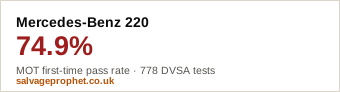
<a href="https://www.salvageprophet.co.uk/mot/mercedes-benz-220"><img src="https://www.salvageprophet.co.uk/badge/mercedes-benz-220.svg" width="340" height="92" alt="Mercedes-Benz 220 MOT Pass Rate: 74.9% - Salvage Prophet"></a>Run a garage or parts site? Embed the Mercedes-Benz 220's top real failure reason instead, linked back here.
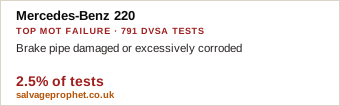
<a href="https://www.salvageprophet.co.uk/mot/mercedes-benz-220"><img src="https://www.salvageprophet.co.uk/badge/failure/mercedes-benz-220.svg" width="340" height="106" alt="Mercedes-Benz 220 most common MOT failure: Brake pipe damaged or excessively corroded (2.5% of tests) - Salvage Prophet"></a>